
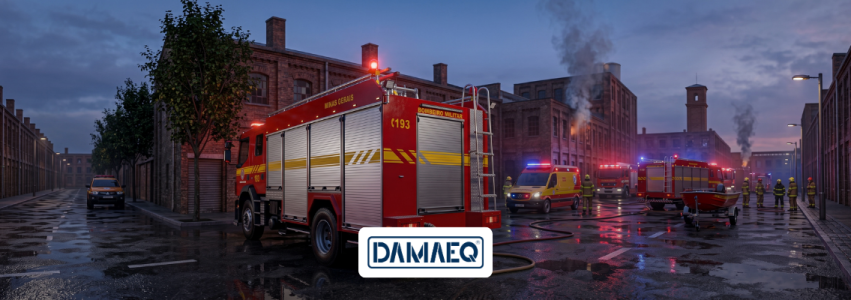
Vehicle accidents, large-scale fires and special emergencies demand fast, organized and technically prepared responses. In these scenarios, having the right equipment makes a difference in expanding the operational capacity of emergency teams and providing better conditions for response. The rescue and salvage vehicle for firefighters is developed precisely to support operations of varying levels of complexity.
Its structure can integrate implements, tools and resources intended for rescuing victims, responding to vehicle incidents and other situations that require specialized action.
More than just carrying equipment, this type of vehicle works as an important operational support unit, allowing professionals to have the appropriate resources available at the scene.
Why the rescue and salvage vehicle is important in emergencies
In a highly complex incident, every stage must be handled with organization and safety. Quick access to equipment can help make the operation more efficient and make the work of the response teams easier.
The rescue and salvage vehicle for firefighters can be configured according to the needs of the operation, bringing together resources for different types of response. This flexibility is especially relevant for fire departments that face a wide variety of incidents and need to be prepared for situations that cannot be handled with conventional equipment.
In addition, having the equipment organized on the vehicle itself makes it easier to travel to the emergency scene and provides a more suitable operational structure for the professionals’ work.
Main applications of the rescue and salvage vehicle for firefighters
- Response to accidents involving vehicles;
- Support for extrication and victim rescue;
- Salvage operations in special situations;
- Organized transport of equipment and tools;
- Support for teams during more complex incidents.
A structure prepared for different incidents
The configuration of the rescue and salvage vehicle for firefighters must take into account the profile of the incidents attended, the available resources and the fire department’s operational routine.
For this reason, aspects such as compartmentalization, equipment layout, carrying capacity and the integration of implements must be evaluated during project development.
A well-planned structure makes resources easier to access and contributes to a more organized response at the scene.
Technology applied to emergency response
Manufacturing rescue implements requires technical knowledge, planning and attention to the requirements of the operation. The goal is to develop a solution that fits the reality of the teams and can keep up with the equipment’s day-to-day use.
In this context, a fire truck is a solution that combines mobility, organization and operational capacity. Domestic manufacturing also favors proximity in service, maintenance and technical support throughout the equipment’s service life.
What to consider when choosing a rescue vehicle
Before defining a rescue and salvage vehicle for firefighters, it is important to assess which incidents are part of the fire department’s routine, which equipment needs to be carried and how the operation will work in the field.
Factors such as ergonomics, accessibility of the compartments, structural strength, organization of resources and ease of maintenance should also be considered. These elements help build a solution aligned with the real needs of the people who will use the equipment.
For emergency operations, having a suitable rescue and salvage vehicle for firefighters means investing in a structure designed to support professionals in situations that demand preparation, agility and precision.
Read more:
- When to use a pump and tank fire truck: learn about the most efficient scenarios
- The importance of tank capacity in fire trucks for firefighting efficiency
DAMAEQ: a reference in rescue and salvage vehicles for firefighters
At DAMAEQ, we develop, manufacture and sell firefighting equipment for public and government agencies, with 100% Brazilian manufacturing and a structure prepared to meet different operational needs.
Our plant in Araucária, Paraná, has 8,000 m² of infrastructure and a manufacturing facility with the capacity to produce up to 30 road implements per month. This industrial know-how allows us to develop projects tailored to the characteristics of each application.
We also provide customer training, usually carried out at our factory before the truck is released, as well as maintenance services and the possibility of technical assistance accreditation in the customer’s region. Our equipment also comes with a factory warranty, providing more confidence during use.
If you need a rescue and salvage vehicle for firefighters developed according to the requirements of your operation, talk to DAMAEQ. Our team can assess the application and advise on the most suitable solution for your needs.
FAQ – Frequently Asked Questions
1. What is a rescue and salvage vehicle for firefighters?
It is a vehicle equipped and configured to support emergency teams in rescue, salvage and response operations for more complex incidents, including vehicle accidents.
2. In which incidents can this type of vehicle be used?
It can be used in accidents involving vehicles, salvage operations and other special emergencies that require organized transport and availability of equipment.
3. Can the vehicle be customized?
The configuration can be developed taking into account the operational needs, the equipment used and the characteristics of the activities carried out by the fire department.
4. What should be assessed before purchasing a rescue vehicle?
It is important to analyze the incident routine, the equipment required, the organization of the compartments, the ease of access to resources and the maintenance conditions.
5. Does DAMAEQ provide training on how to use the equipment?
Yes. Training is usually carried out at the factory itself before the truck is released, helping prepare the team to use the solution properly.
6. Does DAMAEQ provide equipment maintenance?
Yes. In addition to the maintenance service, there is the possibility of accrediting a technical assistance provider located in the customer’s region, as needed.
