
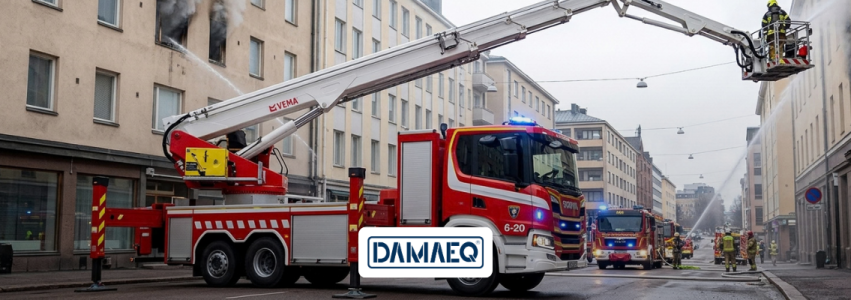
Firefighting equipment for tall buildings is essential to increase the safety, reach and efficiency of emergency teams during incidents in buildings and elevated structures. In these scenarios, being able to reach different floors quickly and safely is one of the main challenges faced by professionals.
Aerial platforms are designed precisely to support situations that require work at height, providing access to elevated locations and a strategic position for fighting fires, carrying out rescues and supporting the teams working on the ground. As a result, this equipment helps make operations in urban environments faster, safer and more efficient.
Why use firefighting equipment for tall buildings?
In urban environments, residential, commercial and industrial buildings can have a large number of floors and different obstacles to access for emergency teams. Internal stairways, elevators and conventional access points may not be enough in certain situations.
In this sense, firefighting equipment for tall buildings expands the operational capacity of the teams by allowing certain tasks to be carried out from the outside.
With an aerial platform, professionals can reach elevated points of the façade, assist in fighting the fire and support rescue operations.
In addition, the use of this equipment helps reduce operators’ exposure to certain risk areas, provided the operation is carried out by trained teams and in accordance with the applicable safety procedures.
How aerial platforms increase safety at incidents
Safety is one of the main factors in firefighting operations at height. During an incident, teams must deal simultaneously with heat, smoke, structural risk, difficult access and the need for evacuation.
In this context, firefighting equipment for tall buildings provides an alternative for reaching external and elevated areas without relying exclusively on the building’s internal access routes.
The platform can also offer greater stability for carrying out certain activities at height, allowing professionals to work from a planned position. This is especially relevant in operations that require significant vertical or horizontal reach.
Main applications of aerial platforms
Possible applications include:
- Support for fighting fires on upper floors;
- External access to façades and hard-to-reach areas;
- Support in rescue and salvage operations;
- Visual inspection of structures and façades;
- Support for teams positioned on the ground;
- Response to incidents involving commercial, residential and industrial buildings.
Operational efficiency in different urban scenarios
The efficiency of an emergency operation depends not only on the availability of professionals, but also on the resources used to reach the scene and carry out the necessary actions.
Firefighting equipment for tall buildings can broaden the teams’ field of action, especially in urban areas with vertical construction.
At an incident, being able to position a platform close to the building makes it possible to create an external access route for certain activities. This can complement the work of fire trucks, hoses, hydrant systems and other resources used in the response.
The choice of road implements should take into account factors such as working height, horizontal reach, load capacity, space available for positioning and the characteristics of the incident.
Main factors for choosing an aerial platform
Before purchasing or adding a platform to the fleet, it is important to analyze the operational needs of the fire department or company responsible for the response.
| Evaluation factor | Importance in the operation |
| Working height | Defines which floors and elevated areas can be reached |
| Horizontal reach | Allows access to points far from the positioning location |
| Load capacity | Determines the weight of professionals and equipment supported |
| Stability | Contributes to safer operations at height |
| Mobility | Makes it easier to move and position in urban areas |
| Stabilization space | Must be compatible with the conditions at the scene |
| Control system | Enables precise positioning of the platform |
| Maintenance | Ensures the availability and reliability of the equipment |
These criteria help define which equipment is best suited for fighting fires in tall buildings.
Technology and preparation for operations at height
In addition to structural characteristics, on-board technology can help improve control and precision when using the platform. Hydraulic systems, operating controls and stabilization features are important elements for the performance of the whole assembly.
However, even with modern equipment, efficiency depends directly on how well the teams are prepared. Training, operating procedures and preventive maintenance must be part of the routine so that firefighting equipment for tall buildings is available and ready to act when needed.
Periodic maintenance also makes it possible to identify wear and potential failures before they compromise the operation. For equipment intended for emergency situations, availability and reliability are directly related to safety.
Aerial platforms as a complement to the emergency fleet
An aerial platform does not replace all the other vehicles and resources used by firefighters. Its role is to complement the available structure and expand the response possibilities.
In a large-scale incident, different pieces of equipment can work in an integrated way. While one unit handles water supply or direct firefighting, the platform can be used to reach elevated areas, support the rescue or provide an external working position.
For this reason, firefighting equipment for tall buildings should be considered within a broader fleet composition and planning strategy.
Read more:
- Technical standards for firefighting implements: why they are essential for safety and operational efficiency
- Fire truck with multi-purpose tank: versatility for civil defense and emergency operations
DAMAEQ: Solutions for fighting fires in tall buildings
DAMAEQ develops, manufactures and sells firefighting equipment for public agencies, fire departments and government institutions. With 100% Brazilian manufacturing, it offers solutions designed for different operational needs, including incidents in tall buildings.
The company’s plant, located in Araucária (PR), has 8,000 m² of facilities and the capacity to produce up to 30 road implements per month. Damaeq also offers training, maintenance services, the possibility of technical assistance accreditation and a factory warranty.
For operations that require firefighting equipment for tall buildings, count on solutions developed according to the characteristics of each application. Contact Damaeq and talk to our team to find the right solution for your operation.
FAQ – Frequently Asked Questions
What equipment is used to reach elevated areas during a fire?
Aerial platforms are used to allow specialized teams to reach certain elevated points of a building. Damaeq offers firefighting solutions developed to meet the operational needs of fire departments and public agencies.
How can safety be improved in fires in tall buildings?
Safety depends on planning, training, operating procedures and the use of equipment suited to the incident. Damaeq works with firefighting solutions that can help expand the operational capacity of teams in different scenarios.
What should be considered when choosing equipment for work at height?
It is important to evaluate working height, horizontal reach, load capacity, stability, mobility, available space and the characteristics of the incidents attended. Damaeq can supply equipment developed to meet the different demands of emergency operations.
What are the advantages of using an aerial platform in urban areas?
The main advantages include the ability to reach elevated areas, support rescue operations, complement firefighting and expand the options for accessing buildings. Damaeq develops equipment focused on the efficiency and safety of firefighting operations.
How can firefighting equipment be kept ready at all times?
Preventive maintenance, periodic inspections, operational tests and team training are essential to keep equipment available and reliable. Damaeq develops robust solutions for operations that demand a high level of availability and performance.
Where can I find firefighting equipment for tall buildings?
The choice should consider the manufacturer’s experience, the technical characteristics of the equipment and the specific needs of the fire department. Damaeq specializes in developing implements and firefighting solutions, offering equipment intended for professional and emergency operations.
