
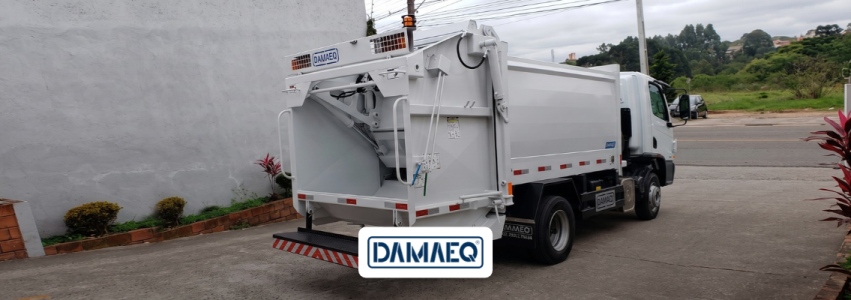
Understanding how to correctly size a refuse compactor is essential for companies and public agencies seeking to improve the efficiency of urban waste collection.
Choosing the right capacity affects the volume carried per trip, crew productivity, operating costs and fleet utilization.
An undersized compactor may require more trips to the disposal site, while an oversized unit can raise acquisition and operating costs without delivering benefits proportional to demand.
For this reason, sizing must take into account the volume of waste collected, its characteristics, the route served and the capacity of the vehicle used.
How to correctly size a refuse compactor?
To define the capacity of a refuse collector (compactor) truck, you need to evaluate both the volume of the body and the weight of the waste carried.
Although these factors are related, they are not the same thing: a hopper can reach its volumetric limit before the truck reaches the maximum permitted weight.
Sizing must also respect the technical limits of the chassis, the weight distribution per axle and the operating capacity of the compaction system.
To understand how to correctly size a refuse compactor, it is essential to analyze the characteristics of the waste, the capacity of the vehicle and the operating conditions. The main factors include:
- Volume of waste collected: estimated quantity per shift, route or region.
- Waste density: relationship between the weight and volume of the material.
- Volumetric capacity of the compactor: space available to receive the waste.
- Vehicle weight limits: technical capacity of the chassis and applicable legal limits.
- Unloading frequency: number of times the truck needs to unload during the operation.
- Route conditions: distance, traffic, topography and accessibility.
- Type of collection: residential, commercial or another operation compatible with the equipment.
Analyzing these criteria together helps identify the most suitable configuration for each service.
Volume and weight: what is the difference in sizing?
One of the most common mistakes when choosing a refuse compactor is to consider only the capacity in cubic meters. Volume indicates how much material fits in the hopper, while weight determines the mass the vehicle can safely carry within its technical and legal limits.
Waste from different sources can have different densities. Lighter materials can fill much of the body without reaching the weight limit. Denser waste, on the other hand, can bring the truck to its mass limit before the entire hopper is filled.
For this reason, knowing how to correctly size a refuse compactor requires evaluating how the waste behaves in the actual operation, including variations between neighborhoods, days of the week and types of generators.
How does compaction affect capacity?
The compaction system reduces the volume occupied by the waste, making it possible to carry more material than the same volume of uncompacted waste. However, compaction does not increase the vehicle’s legal load capacity.
Efficiency depends on the characteristics of the waste, the equipment design and the operating conditions. Materials with different compositions can produce different results, so it is not advisable to adopt a generic compaction rate as a performance guarantee.
Which factors affect operational performance?
The efficiency of a refuse truck does not depend only on the nominal capacity of the equipment. Performance is also related to route organization, collection time, the distance to the unloading point and the frequency of stops.
A route with a large volume of waste and long distances to the disposal site may require a different strategy from the one applied in densely populated areas, where collection points are close to each other.
Analyzing operational data makes it possible to identify whether the main bottleneck lies in the compactor’s capacity, in route planning or in the time needed to carry out the collection.
Unloading frequency and productivity
When the hopper reaches capacity quickly, the truck may need to make more trips to unload the waste. This increases travel time and can reduce the number of collection points served per shift.
On the other hand, using higher-capacity equipment is not always the best solution. If route demand is low or the streets make it difficult for larger vehicles to circulate, the additional cost may not be worth it.
The ideal choice must balance capacity, maneuverability, productivity and operating cost.
How to choose the ideal capacity for each operation?
To know how to correctly size a refuse compactor, you need to survey the amount of waste collected over a given period. With this data, it is possible to estimate demand per shift and compare different compactor configurations.
The table below gathers important criteria to support this assessment.
| Sizing factor | Impact on the operation | What to evaluate |
| Volume collected | Determines storage demand | Average volume and collection peaks |
| Waste density | Influences the weight carried | Weight per volume of material |
| Body capacity | Defines the available space | Nominal volume of the compactor |
| Chassis capacity | Limits the load carried | Gross vehicle weight and axle limits |
| Route profile | Affects time and maneuverability | Distances, traffic and accessibility |
| Unloading frequency | Influences productivity | Number of trips per shift |
| Maintenance | Affects fleet availability | Failure history and preventive plan |
This data helps compare alternatives and identify the capacity that best meets the actual conditions of the service.
Practical example of compactor sizing
Imagine an operation that collects an average of 18 tons of waste per shift. To assess the required equipment, management needs to know the average density of the waste after compaction, the usable volume of the hopper and the vehicle’s load limits.
If the available volume is filled before the weight limit is reached, volumetric capacity will be the limiting factor. If the truck reaches the permitted weight limit before the hopper is full, load capacity must be considered the main constraint.
The example shows that it is not enough to select a compactor by its number of cubic meters. You need to cross-check data on volume, density, weight and expected productivity.
In practice, sizing should use measured operational data and the technical specifications provided by the manufacturer of the implement and the chassis.
Maintenance and equipment configuration also make a difference
Preventive maintenance helps preserve the performance of the compaction system and reduce unexpected downtime. Hydraulic components, compaction mechanisms, safety devices and other systems must be inspected in accordance with the manufacturer’s guidelines.
It is also important to check compatibility between the implement and the chassis. An inadequate configuration can compromise weight distribution, handling and safety during operation.
In addition, operator training helps standardize procedures, make correct use of the equipment’s features and identify signs of failure before they cause major interruptions.
Read more:
- How to choose a refuse collector (compactor) for severe operations: efficiency under high demand and adverse conditions
- When to renew your road implement fleet: signs and indicators your company cannot ignore
DAMAEQ: solutions to optimize waste collection and transport
DAMAEQ develops, manufactures and sells road implements to meet a range of operational needs. For urban cleaning and waste collection services, choosing equipment that matches demand is essential to improve productivity, make the most of load capacity and contribute to fleet efficiency.
Located in Araucária (PR), Brazil, the company has an 8,000 m² manufacturing facility and the capacity to produce up to 30 road implements per month. Damaeq also offers training, maintenance services, the possibility of accrediting technical assistance in the customer’s region and a factory warranty, subject to the applicable conditions.
When evaluating how to correctly size a refuse compactor, it is important to consider the volume and density of the waste, the vehicle’s load limits, the characteristics of the routes and the unloading frequency. These factors help identify a solution that fits the needs of the operation and avoid unnecessary costs.
Contact Damaeq to talk with our team, learn about the available solutions and evaluate the options to meet the demands of your waste collection fleet.
FAQ – Frequently Asked Questions
1. How to choose the size of a refuse compactor truck?
The choice depends on the volume and weight of the waste collected, the characteristics of the routes and the limits of the vehicle. Damaeq can help assess operational needs and identify an implement configuration suited to the application.
2. What is the difference between volumetric capacity and load capacity?
Volumetric capacity represents the space available for waste, usually measured in cubic meters. Load capacity relates to the weight the vehicle can carry within technical and legal limits. Damaeq can guide the assessment of implement requirements for each operation.
3. How to increase the efficiency of urban waste collection?
Route planning, proper sizing of compactors, preventive maintenance and operator training can all help improve productivity. Damaeq offers equipment for urban cleaning and support services to meet customers’ needs.
4. What to consider before buying a refuse compactor truck?
It is important to evaluate collection volume, waste density, chassis capacity, road conditions, unloading frequency, maintenance and operating cost. Damaeq can assist in analyzing the application to guide the choice of a suitable solution.
5. Why is preventive maintenance important for refuse compactors?
Preventive maintenance helps preserve equipment performance, reduce unexpected failures and increase its availability for collection. Damaeq offers maintenance and training services, according to the applicable solutions and conditions.
6. Where to find refuse compactors for urban collection?
Damaeq develops and sells road implements for different applications, including urban cleaning. Contact the company to share your fleet’s needs and learn about the solutions available for your operation.
