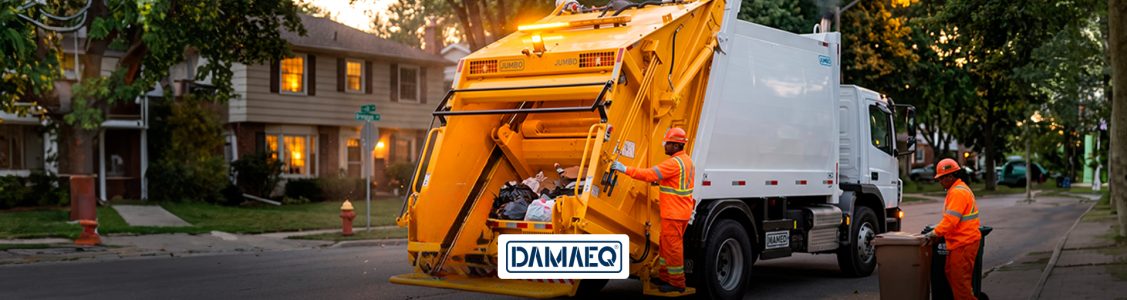
Knowing how to choose a refuse collector (compactor) for severe operations is extremely important for public managers and companies responsible for urban cleaning in highly demanding operating scenarios.
In this article, we cover the main criteria for selecting a refuse collector (compactor) suited to severe operations and how to ensure continuous performance even under a heavy workload. Check it out!
What a refuse collector (compactor) is and its role in severe operations
The refuse collector (compactor) is a road implement designed to collect, compact and transport urban solid waste efficiently.
In severe operations, it must handle a large daily collection volume, constant stops and long routes, often in difficult traffic conditions.
Its main function is to optimize waste transport, reducing the number of trips to the final destination and increasing fleet productivity.
As a result, how to choose a refuse collector (compactor) for severe operations becomes a central question in the efficiency of urban waste management.
How to choose a refuse collector (compactor) for severe operations under high demand
Choosing a refuse collector (compactor) for severe operations requires careful analysis of technical and operational factors. In high-demand environments, every detail of the equipment directly affects collection efficiency, cost reduction and service continuity. That is why understanding the expected field performance is essential before defining the ideal model.
Load capacity and operating volume
The equipment’s capacity is one of the first points to analyze when defining how to choose a refuse collector (compactor) for severe operations.
The higher the waste demand, the greater the storage and compaction capacity should be, allowing more efficient routes and fewer trips.
For this reason, how to choose a refuse collector (compactor) for severe operations also involves evaluating the balance between usable volume and collection frequency.
Structural strength and durability
In severe operations, the equipment is subject to constant wear.
Therefore, it is essential to evaluate the robustness of the structure, the quality of the materials and the strength of the compaction system.
An essential point in how to choose a refuse collector (compactor) for severe operations is making sure the equipment withstands continuous operation without loss of performance.
Compaction system efficiency
The efficiency of the hydraulic and compaction system directly affects operating performance.
A good collector should ensure uniform compaction, maximum use of the internal volume and continuous operation without loss of performance.
Performance in adverse conditions
Therefore, when analyzing how to choose a refuse collector (compactor) for severe operations, it is important to consider:
- Ease of maneuvering in dense urban areas;
- Performance on different types of terrain;
- Stability during loading;
- Resistance to impacts and vibration.
These factors ensure greater safety and efficiency during operation.
The importance of maintenance and technical support
The continuity of operations depends directly on proper maintenance of the equipment.
A refuse collector (compactor) for severe operations must have specialized technical support and easy access to spare parts.
Preventive maintenance reduces unexpected failures and ensures greater fleet availability.
In addition, equipment with good technical support performs better over time.
Operational efficiency and cost reduction
Knowing how to choose a refuse collector (compactor) for severe operations also involves a cost-benefit analysis.
Efficient equipment reduces:
- Fuel consumption per route;
- Number of trips to the final destination;
- Corrective maintenance costs;
- Operating time per collection.
This efficiency directly affects public management and the financial sustainability of the service.
Operational safety in collection routines
Operator safety is an essential factor when choosing equipment.
A refuse collector (compactor) for severe operations must offer:
- Hydraulic safety systems;
- Intuitive operating controls;
- Ergonomic structure for operators;
- Reduced exposure to risks during collection.
These elements contribute to safer and more efficient operations.
Damaeq and refuse collector (compactor) solutions
Damaeq develops robust road implement solutions, including refuse collectors (compactors) designed to meet intense demand and severe operations.
With a focus on engineering, durability and performance, the company delivers equipment prepared to withstand large collection volumes and demanding operating conditions.
Whether in urban centers or industrial areas, its solutions are designed to optimize fleet efficiency and ensure greater productivity.
Damaeq: a benchmark in refuse collectors (compactors) for severe operations
When investing in a refuse collector (compactor) for high-demand operations, relying on a specialized company is essential to ensure operational efficiency, robustness and maximum reliability in the field. Damaeq is a benchmark in developing solutions for urban cleaning and waste management, offering equipment designed to withstand intense conditions and demanding routines.
With a focus on performance, durability and advanced engineering, the company delivers refuse collectors (compactors) prepared for severe operations, contributing to greater productivity and better use of the fleet.
Get in touch with Damaeq and find out how our refuse collectors (compactors) can raise the performance and efficiency of your urban cleaning operations.