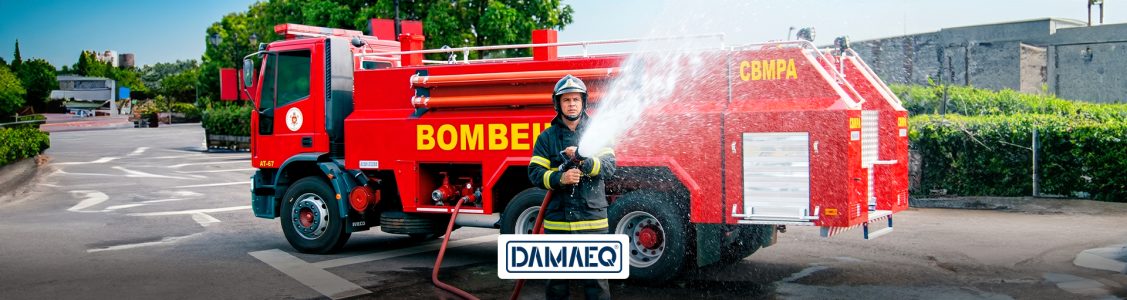
The importance of tank capacity in fire trucks is an essential topic for understanding how a vehicle’s structure directly affects operational performance in emergency situations.
Throughout this article, we look at how different tank capacities affect the performance of fire trucks and why this factor should be carefully evaluated by public managers, fire departments and industrial fire brigades.
What tank capacity means in fire trucks
Tank capacity is the volume of water that the vehicle can carry for immediate use in firefighting.
This volume is usually measured in liters and varies according to the type and purpose of the vehicle.
Models available on the market may offer capacities such as:
- 1,500 liters;
- 2,500 liters;
- 4,000 liters;
- 6,000 liters;
- 8,000 liters;
- 10,000 liters;
- 12,000 liters.
Choosing the ideal capacity depends on the operational characteristics of each fire department.
The importance of tank capacity in fire trucks lies precisely in the relationship between endurance, mobility and the need for response.
How tank capacity affects operational endurance
One of the main factors related to the importance of tank capacity in fire trucks is water endurance.
The larger the tank, the longer the crew can operate without refilling.
This is especially relevant in places where:
- There are no hydrants nearby;
- Access to water is limited;
- Travel to refill is time-consuming;
- The incident requires prolonged operation.
In rural, industrial or forest settings, this endurance can be decisive in bringing a fire under control.
The relationship between capacity and response speed
Although larger tanks offer greater endurance, it is important to consider that the increased volume carried also affects the weight and mobility of the vehicle.
For this reason, the importance of tank capacity in fire trucks must be analyzed in balance with other operational factors.
Smaller tanks usually provide:
- Greater urban agility;
- Better maneuverability;
- Quick response in dense areas.
Larger tanks, in turn, offer:
- Prolonged operation;
- Less dependence on refilling;
- Greater capacity for major incidents.
The ideal choice depends on the operating environment.
Smaller capacities: agility in urban operations
Trucks with capacities between 1,500 and 4,000 liters are widely used in urban centers.
These vehicles offer excellent mobility and can reach locations more easily.
They are suited to:
- Residential fires;
- Commercial areas;
- Condominiums;
- First response.
In these cases, the importance of tank capacity in fire trucks is tied to how quickly the truck arrives and begins firefighting.
Since hydrants are more widely available in cities, refilling tends to be simpler.
Intermediate capacities: operational balance
Tanks between 4,000 and 6,000 liters are a versatile solution.
They combine good endurance with mobility suited to different scenarios.
These models serve well:
- Mid-sized municipalities;
- Industrial areas;
- Logistics centers;
- Extended urban operations.
Large capacities: maximum endurance
Trucks with tanks between 8,000 and 12,000 liters are designed for operations that require a large volume of water.
They are ideal for:
- Complex industrial fires;
- Rural areas;
- Forest fires;
- Operations in remote regions.
In these scenarios, the importance of tank capacity in fire trucks is even more evident.
The endurance they provide reduces the need for trips to refill and allows continuous operation.
Tank capacity and pump system efficiency
Having a large volume of water is not enough.
Operational efficiency depends on the integration between the tank and the hydraulic system.
The importance of tank capacity in fire trucks is directly linked to the pump’s ability to use this resource efficiently.
An adequate system should deliver:
- Constant pressure;
- Efficient flow;
- Balanced distribution;
- Precise operational control.
This integration ensures better performance during firefighting.
How to choose the ideal capacity
When assessing the importance of tank capacity in fire trucks, a few criteria should be considered.
Predominant type of incident
- Urban fires;
- Industrial fires;
- Forest fires;
- Highway incidents.
Available infrastructure
- Presence of hydrants;
- Nearby water reservoirs;
- Ease of water supply.
Coverage area
- Operating distances;
- Type of access;
- Average response time.
Fire department profile
- Number of vehicles;
- Available resources;
- Operational strategy.
Combining these factors guides the most efficient decision.
The importance of tank capacity in fire trucks in strategic decision-making
When investing in a new vehicle, understanding the importance of tank capacity in fire trucks is essential to ensure technical and operational return.
The right choice directly affects:
- Response efficiency;
- Operating costs;
- Safety;
- Operational durability.
Each capacity meets a specific need.
Therefore, the decision must take into account the real operating context.
Damaeq: your best choice in road implements for fire trucks
By understanding the importance of tank capacity in fire trucks, it becomes clear that choosing the right configuration is decisive for ensuring endurance, operational efficiency and fast response in the most diverse incidents. Each operation requires a specific capacity, and having a specialized company makes all the difference in ensuring that every investment delivers real performance and maximum reliability in the field.
Damaeq positions itself as a strategic partner for fire departments, public agencies and industrial fire brigades, developing fire trucks with different tank capacities, always with a high manufacturing standard, advanced technology and a total focus on each customer’s operational needs.
With solutions for urban, industrial and rural operations, the company offers equipment designed to provide the ideal balance between water endurance, mobility and performance.
Get in touch and find out how choosing the right tank capacity can raise the operational standard of your fleet and ensure maximum firefighting efficiency.