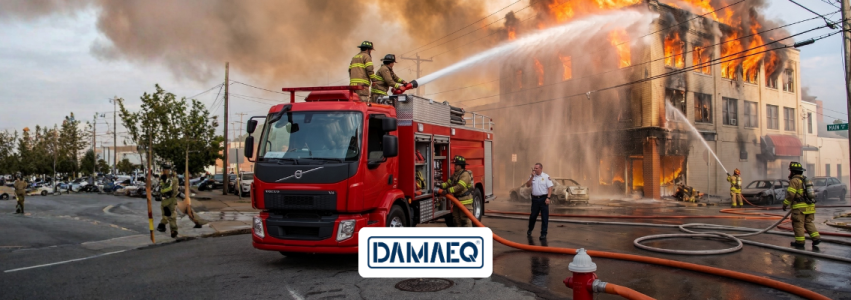
First of all, knowing when to use a pump and tank fire truck is one of the main questions for managers of fire departments, public agencies and teams responsible for fire safety. Choosing the right equipment for each type of incident is essential to ensure a fast response, effective firefighting and greater safety during operations.
In this article, you will learn in which scenarios the pump and tank truck (ABT) is the best choice, get to know its main applications and find out how this equipment contributes to faster, more efficient and more reliable operations.
When to use a pump and tank fire truck in areas without a hydrant network
One of the clearest scenarios for when to use a pump and tank fire truck is responding in rural areas, highways, remote industrial districts or neighborhoods where the hydrant network is scarce or nonexistent.
Autonomy to start the attack immediately
In these cases, the vehicle’s own water reserve makes it possible to start fighting the fire as soon as the crew arrives on site, gaining minutes that can be decisive in containing the spread of the flames.
Less dependence on water supply points
This autonomy also reduces the need to leave the scene to refill during the first minutes of the incident, an essential factor in fires that are still in their early stage and can be brought under control more quickly.
Medium-sized fires in urban areas
In urban areas, the ABT also plays a relevant role, especially when the nearest hydrant is far from the fire or has low pressure. The pump and tank truck allows the crew to begin attacking the flames while another vehicle makes the connection to the public network.
Main applications in urban environments
The most common situations include:
- Fires in homes and small businesses;
- Vehicle fires on public roads;
- Support for structure fires while continuous water supply is being organized;
- Simultaneous incidents when other vehicles are already in operation.
Support for crews in more complex incidents
When to use a pump and tank fire truck is also related to logistical support in large-scale incidents, such as industrial fires, wildfires or special operations.
Reinforcing the water supply
In these situations, the ABT acts as a mobile water reserve for other vehicles, extending the operation’s autonomy and reducing the time spent traveling to refill.
More efficiency in prolonged operations
This support is especially important in remote regions or places with little infrastructure, ensuring that crews can keep fighting the fire without interruption.
Operational efficiency and return for the department
Above all, beyond technical performance, the ABT truck is an investment with excellent value for departments seeking greater operational efficiency.
Benefits for the operation
The main gains include:
- Shorter response time in incidents with no hydrant nearby;
- Less dependence on external water supply infrastructure;
- Versatility to operate in both urban and rural areas;
- Ability to start fighting the fire immediately upon arrival.
These characteristics make the equipment a strategic choice for municipalities and departments that cover large areas or regions with limited infrastructure.
Maintenance and readiness as part of the decision
Knowing when to use a pump and tank fire truck also means making sure the vehicle is always in full operating condition. Since this is immediate-response equipment, any mechanical or hydraulic failure directly compromises the safety of the crew and of the people being served.
For this reason, departments that use road implements, such as the ABT fire truck, must maintain strict routines of preventive maintenance, pumping system inspection and periodic testing of the water reserve, ensuring the vehicle is ready to act the moment it is called.
Read more: How to choose the ideal fire truck for each type of incident: a practical guide for public managers
Damaeq: a benchmark in pump and tank trucks for firefighting
Choosing the right fire truck is essential to ensure fast, safe and efficient responses to different types of incidents. Damaeq is a benchmark in the development of Pump and Tank (ABT) trucks, offering solutions designed to meet the needs of fire departments and public agencies with high performance, robustness and reliability.
With a focus on technology, quality and durability, the company manufactures ABT trucks in 4,000, 5,000 and 6,000-liter versions, developed to provide greater firefighting autonomy, operational efficiency and safety for crews in the field. Each unit is built to withstand the most diverse operating conditions, ensuring performance and availability when every minute counts.
Get in touch with Damaeq and find out how the company’s Pump and Tank trucks can contribute to faster, more efficient and safer firefighting operations.
FAQ – Frequently Asked Questions
1. What is a pump and tank fire truck?
The pump and tank fire truck (ABT) is a vehicle equipped with a high-flow pump and a water tank, developed to fight fires quickly and with autonomy. Damaeq manufactures ABT models designed to deliver high performance, reliability and efficiency in different types of operations.
2. In which situations is the pump and tank truck used the most?
The ABT is suited to incidents in urban, rural and industrial areas, on highways, and in places with no hydrant network or where the water supply is limited. Damaeq trucks are developed to handle these scenarios with maximum safety and operational efficiency.
3. What are the advantages of a pump and tank truck?
The main benefits include the autonomy to start fighting the fire immediately, less dependence on hydrants, fast response to incidents and versatility to operate in different environments. Damaeq develops equipment that combines technology, robustness and high operating capacity.
4. What is the water capacity of a pump and tank truck?
Capacity varies according to the model and the needs of the operation, and can meet different firefighting demands. Damaeq offers ABT trucks in 4,000, 5,000 and 6,000-liter versions, providing suitable solutions for a wide range of departments and public agencies.
5. How can you ensure the efficiency of a pump and tank truck?
Efficiency depends on preventive maintenance, periodic inspections of the hydraulic and pumping systems, and correct operation of the equipment. In addition to manufacturing high-quality trucks, Damaeq builds vehicles prepared to deliver reliability and performance under the widest range of conditions of use.
6. Where to buy a pump and tank fire truck?
The best option is to buy the equipment from a specialized manufacturer that offers quality, technical support and solutions developed around the needs of the operation. Damaeq is a benchmark in manufacturing pump and tank trucks, supplying robust, safe equipment prepared to meet the demands of fire departments and public agencies.