
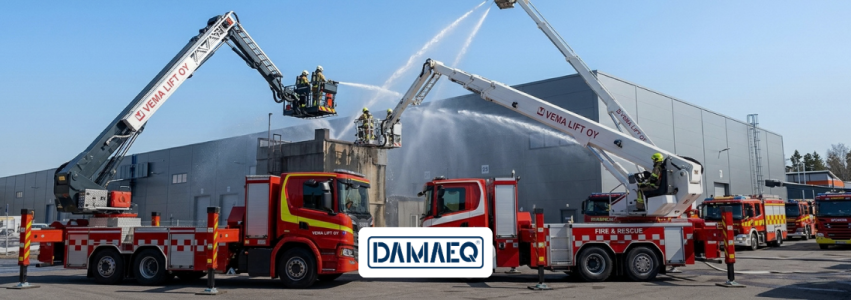
The choice between articulated or telescopic platforms can make a difference in the efficiency and safety of fire department operations that require access to elevated locations. Each system has specific reach, mobility and positioning characteristics and is suited to different types of incidents.
In building fires, high-angle rescues and operational support, understanding the differences between these units helps managers and fire departments identify the solution best suited to the operation.
Articulated or telescopic platforms: what are the main differences?
Articulated platforms have segments connected by joints that allow the path of the boom assembly to be changed during operation. This feature provides greater flexibility to reach points that are not directly above the vehicle.
Telescopic platforms, on the other hand, use sections that extend in a straight line. This system favors operations that require more direct vertical and horizontal reach, especially when there is adequate space to position and stabilize the vehicle.
For this reason, the choice between articulated or telescopic platforms should consider not only the height required, but also the environment, the obstacles present and the type of incident being handled.
How do articulated platforms work?
Articulated platforms have booms made up of several segments, allowing movements that make it easier to reach areas behind obstacles or in hard-to-approach positions.
In urban operations, this capability can be important when there are trees, architectural structures, poles, canopies or other elements that make conventional vertical access difficult.
The main applications include:
- Fighting fires in buildings;
- Access to upper floors;
- Rescue operations;
- Support in industrial areas;
- Response in structures with nearby obstacles;
- Positioning crews at different angles.
The ability to change the boom path makes it possible to adapt the platform positioning to the specific characteristics of the scene.
Greater positioning flexibility
One of the characteristics of articulated platforms is the ability to work with different boom configurations. This allows the crew to reach certain points without depending exclusively on a vertical or straight-line path.
How do telescopic platforms work?
Telescopic platforms have booms made up of extendable sections that move out in a straight line. The system is especially used when it is necessary to reach great heights or distances along a more direct path.
In fire department incidents, they can be used in firefighting, rescue, structural inspection and access to elevated areas.
The telescopic configuration can be a good option in places where there is enough space to position the vehicle and carry out the stabilization required for the operation.
Reach and vertical access
In certain incidents, the direct reach provided by the telescopic system makes it easier to access elevated points. Assessing the working height, the horizontal reach and the ground conditions should be part of operational planning.
Articulated or telescopic platforms: comparing applications
The choice between articulated or telescopic platforms depends on the characteristics of the incident and the needs of the fire department. There is no single configuration for every scenario, since each system offers specific capabilities.
| Feature | Articulated platform | Telescopic platform |
| Boom movement | Articulated segments | Linear extension |
| Access over obstacles | Greater flexibility | Depends on positioning |
| Vertical reach | High | High |
| Positioning | More versatile in complex scenarios | More direct |
| Environments with obstacles | Can make access easier | Requires positioning planning |
| Applications | Rescue, firefighting and access in complex locations | Firefighting, rescue and direct access |
| Operational planning | Considers different approach angles | Prioritizes the path and the stabilization area |
This comparison shows why analyzing articulated or telescopic platforms requires considering the working environment and not only the maximum height the equipment can reach.
What factors should be considered before choosing a platform?
To determine which road implement best suits a given operation, it is important to assess technical and operational factors. The main ones include working height, horizontal reach, platform capacity, vehicle stability and the space available for stabilization.
The characteristics of urban roads, possible obstacles, the frequency of incidents and the specific needs of the fire department should also be considered.
Another important point is operator training. Equipment performance depends on proper operating procedures, preventive maintenance and crew training.
Technology and safety in fire department operations
Regardless of the choice between articulated or telescopic platforms, the equipment must be prepared to offer stability and control during work at height.
Stabilization systems, precise controls, safety devices and periodic maintenance are important elements for preserving operational reliability.
In addition, crew preparation should include pre-use inspection procedures, assessment of ground conditions and identification of possible obstacles or hazards present at the scene.
How to choose the right solution for your fire department?
The decision between articulated or telescopic platforms should start from the real needs of each operation. A fire department that works predominantly in dense urban areas may have different demands from a team responsible for industrial regions or very tall structures.
For this reason, it is important to analyze the incident profile, the available infrastructure, the characteristics of the buildings served and the mobility and reach requirements.
Technical evaluation also makes it possible to identify which configurations can contribute to greater operational efficiency, crew safety and better use of the investment made by the fire department.
Read more:
- Road implements for firefighting: learn how this equipment improves agility in operations
- ABT fire truck: learn how it works and why it is essential in firefighting
DAMAEQ: solutions for fire department operations at height
DAMAEQ develops, manufactures and markets firefighting equipment for public agencies, fire departments and government institutions. With 100% Brazilian manufacturing, it offers solutions designed for different operational needs, including incidents that require access, rescue and work at elevated locations.
The company’s plant, located in Araucária (PR), has 8,000 m² of facilities and the capacity to produce up to 30 road implements per month. Damaeq also offers training, maintenance services, the possibility of technical service accreditation and a factory warranty.
To decide between articulated or telescopic platforms, it is important to consider factors such as working height, reach, operating environment and incident profile. Contact us and talk to our team to evaluate the solution best suited to your fire department’s needs.
FAQ: Frequently asked questions
1. Which platform is recommended for fire department operations?
The choice depends on the characteristics of the operation. Damaeq can assess factors such as height, reach, environment and application to guide the choice between articulated or telescopic platforms.
2. What is the difference between an articulated platform and a telescopic one?
The articulated platform uses movable segments to change the boom path, while the telescopic one extends in a straight line. Damaeq develops solutions considering the specific needs of each application.
3. Can aerial platforms be used in firefighting?
Yes. This equipment can support firefighting, rescue and access to elevated areas, depending on the configuration and project specifications. Damaeq offers solutions aimed at the operational needs of fire departments.
4. What should be evaluated before acquiring a platform for fire departments?
It is important to consider working height, horizontal reach, capacity, stability, space for stabilization, ground characteristics and incident profile. The Damaeq team can assist with the technical evaluation of the application.
5. How can safety be ensured when using aerial platforms?
Operator training, inspections, preventive maintenance and compliance with operating procedures are essential. Damaeq also offers training to its customers and maintenance services for its equipment.
6. Where can I find platforms for fire department operations?
Damaeq develops and manufactures solutions for different operational applications, offering technical support, training and service. Contact the company to evaluate your fire department’s needs and learn about the available options.
